

1. Introduction
In the ever - evolving landscape of optical technologies, MEMS (Micro - Electro - Mechanical Systems) FSM (Fast Steering Mirrors) have emerged as a revolutionary component. These tiny yet highly sophisticated devices play a pivotal role in various applications, from high - precision optical communication to advanced imaging systems.
2. Working Principle of MEMS FSM
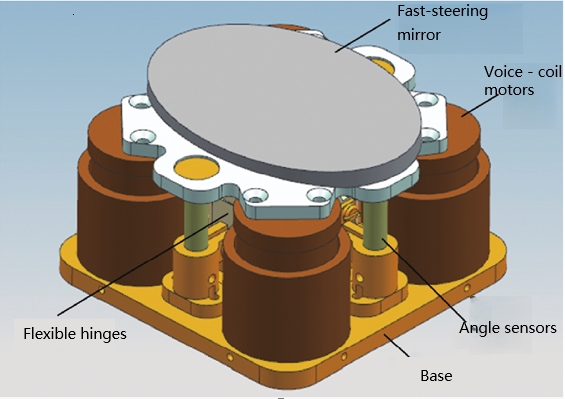
This is a schematic diagram showing the structure of a Fast - Steering Mirror (FSM), and the components and their descriptions are as follows:
3.1 Miniaturization
One of the most significant advantages of MEMS FSMs is their miniaturized size. These devices can be fabricated on a silicon wafer using micro - machining techniques, which allows for the integration of multiple components on a single chip. This miniaturization not only reduces the overall size and weight of optical systems but also enables the development of compact and portable devices.
3.2 High - Speed Response
MEMS FSMs are capable of achieving high - speed response times, often in the millisecond or even microsecond range. This fast response is crucial for applications such as optical communication, where rapid beam - steering is required to compensate for atmospheric turbulence or to establish and maintain communication links with moving targets.
3.3 High Precision
They can provide high - precision beam - steering control, with angular resolutions in the micro - radian or even sub - micro - radian range. This precision is essential for applications like high - resolution imaging, where accurate control of the optical path is necessary to obtain sharp and clear images.
4. Applications of MEMS FSM
4.1 Optical Communication
In free - space optical communication systems, MEMS FSMs are used to steer the laser beam to establish and maintain communication links between different nodes. They can compensate for the movement of the transmitting and receiving platforms, as well as the effects of atmospheric turbulence, ensuring reliable and high - bandwidth communication.
4.2 Imaging Systems
In microscopy and telescopic imaging, MEMS FSMs are employed to correct for optical aberrations and to perform fast scanning of the optical field. In confocal microscopy, for example, the MEMS FSM can rapidly scan the laser beam across the sample, enabling high - speed and high - resolution imaging of biological specimens.
4.3 Adaptive Optics
Adaptive optics systems use MEMS FSMs to correct for the wavefront distortions introduced by the atmosphere or other optical elements. In astronomical telescopes, MEMS FSMs can compensate for the blurring effects of atmospheric turbulence, allowing astronomers to obtain sharper images of celestial objects.