

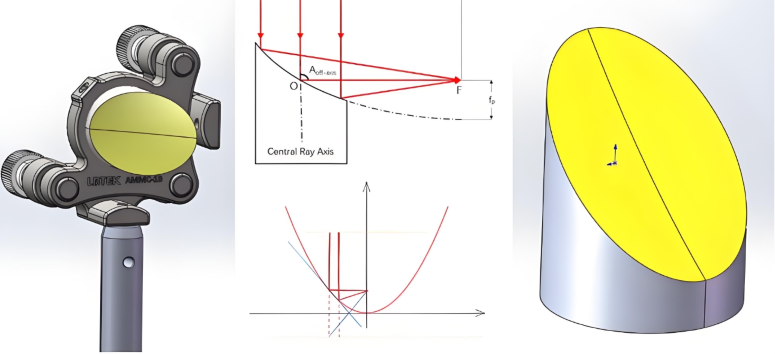
Structure and Design
A parabolic mirror is composed of a solid of revolution generated by rotating a parabola. Its design requires precise calculation of the parameters of the parabola to ensure the required optical performance. The reflective surface is usually coated with metal or other materials with high reflectivity to improve the reflection efficiency.

The parabolic mirror is an important optical element, and its reflective surface has the shape of a paraboloid of revolution. This special geometric shape endows the parabolic mirror with unique optical properties, making it excellent in focusing and generating parallel light beams. Parabolic mirrors are widely used in fields such as astronomical telescopes, radar antennas, satellite communications, and laser systems.
Application Cases
1. Space Telescopes: In space astronomical telescopes, the off-axis parabolic mirror is widely used. Taking the Hubble Space Telescope as an example, its optical system partly adopts the design of the off-axis parabolic mirror. Due to the absence of atmospheric interference in the space environment, the off-axis parabolic mirror can fully utilize its advantages of high resolution and high contrast to conduct high-precision observations of distant galaxies, nebulae and other celestial bodies, providing astronomers with a large number of precious cosmic images and data, and laying a clear observational foundation for the research on processes such as the formation and evolution of galaxies and the birth of stars.

2. Ground Telescopes: In some large ground-based astronomical telescopes, the off-axis parabolic mirror also has important applications. For example, in the optical feed systems of some radio telescopes, the off-axis parabolic mirror is used to focus radio waves, which can improve the collection efficiency and resolution of radio signals by the telescope. Moreover, in telescopes for multi-band observations, the off-axis parabolic mirror can better cooperate with detectors in different bands to achieve astronomical observations in multiple bands from visible light to infrared.

3. Radar and Satellite Communications: In radar and satellite communication systems, parabolic mirrors are used to generate highly directional radio frequency beams or receive signals from specific directions.
4. Laser Systems: In laser systems, parabolic mirrors can be used to focus or shape laser beams to meet specific application requirements, such as laser cutting, welding, or medical applications.
5. Illumination and Projection: In some lighting and projection equipment, parabolic mirrors are also used to focus light sources to improve lighting efficiency or form the required light beam distribution.